If you have ever stood in front of a wall of pilates balls and wondered what size of pilates ball do I need, you are not alone. This guide is written for UK home pilates users, beginners returning to movement, and anyone setting up a small studio. We cover both pilates ball families, the small 18-25 cm soft ball and the large 45-75 cm stability ball, with a height-based sizing chart and clear answers on when to pick a 7 inch, 9 inch or 10 inch mini ball.
TL;DR
- Two different balls, two different jobs. The small "mini" or soft pilates ball (18-25 cm / 7-10 inch) goes between your knees, behind your back, or under your neck for spinal articulation work. The large pilates ball (also called a gym, swiss or stability ball, 45-75 cm) is sized to your height for seated and supported exercises.
- Mini ball size by use. 7 inch (18 cm) suits small frames, hand work and tight inner-thigh squeezes. 9 inch (23 cm) is the all-round favourite and fits most adults. 10 inch (25 cm) gives more cushion behind the lower back and feels gentler under the neck.
- Large ball size by height. Under 5'0" = 45 cm. 5'1"-5'7" = 55 cm. 5'8"-6'1" = 65 cm. 6'2"-6'7" = 75 cm. When sitting on the ball your hips should sit slightly higher than your knees with feet flat.
- If you can only buy one, get the 23 cm soft ball. It covers more pilates exercises and stores easily. Add a 55 cm or 65 cm stability ball later if you want full pilates and rehab use.
- Our picks. The flexa.fit Pilates Ball (18cm) covers all the mini-ball drills, and the flexa.fit Anti-Burst Gym Ball handles the large stability work.
Why size matters more than brand
Pilates balls look almost identical at first glance, but the size you choose changes the exercise, not just the comfort. With the small soft ball, a couple of centimetres either way changes how much your inner thighs have to grip or how much your spine can articulate over the surface. With the large ball, the wrong size pushes your hips below your knees when seated, which loads the lower back and stops you using the ball as a stable platform for bridges, squats or supported press-ups.
The NHS strength and flexibility plan recommends balanced core work as part of weekly activity for adults, and a correctly sized ball makes those exercises far easier to perform safely at home (NHS strength and flex plan). The Chartered Society of Physiotherapy also lists low-impact, supported exercise like pilates as a useful route back into movement after injury or a long sedentary spell (CSP public information).
The two pilates ball families, explained
Before you pick a size, it helps to know which ball you are actually being sold. The same word "pilates ball" gets used for two very different products. Pick the wrong family and the size guide does not apply.
1. The small "mini" pilates soft ball (18-25 cm / 7-10 inch)
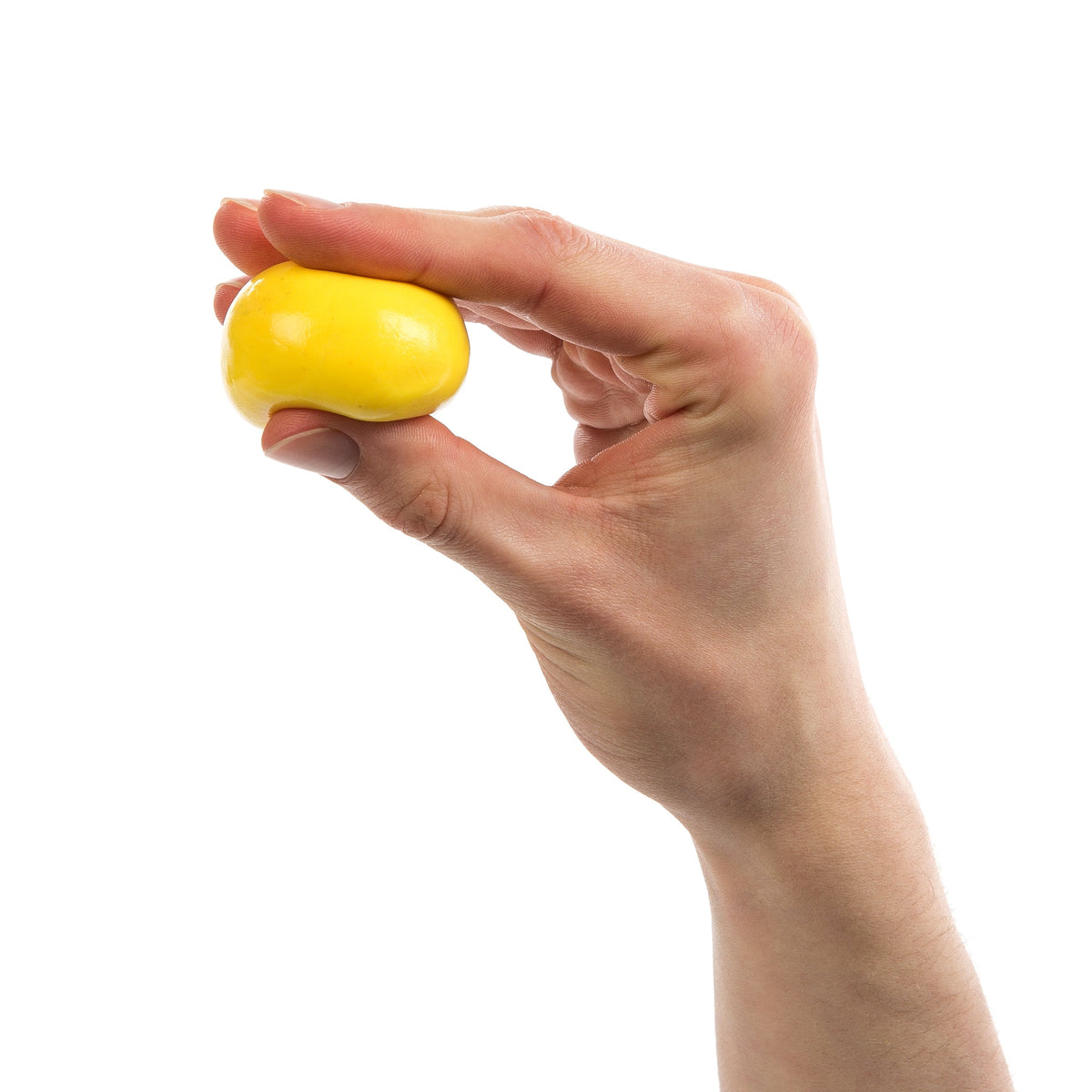
Also called the soft ball, mini ball, overball or toning ball. It is soft, slightly squashy when fully inflated, and roughly the size of a small football or honeydew melon. You under-inflate it on purpose so it gives a little when you press into it.
Used for:
- Squeezing between the knees or ankles to fire the inner thighs and pelvic floor
- Placing under the sacrum or lower back for supported pelvic tilts and bridge work
- Sitting behind the neck or upper back for spinal articulation and chest opening
- Holding overhead or between the hands for shoulder, arm and grip-strength drills
If you are following a classic mat pilates class or a postnatal routine, the small ball is almost always the one being demonstrated. Yoga Journal has a clear write-up of how mini-ball squeezes recruit the deep core during seated and supine work, which is why pilates teachers reach for it so often (Yoga Journal).

2. The large pilates / gym / swiss / stability ball (45-75 cm)
Also called the gym ball, swiss ball, fitball, exercise ball or birth ball. These are big enough to sit on, and they are inflated firm so they hold your bodyweight without collapsing. The colours and PVC finish vary, but the sizing system is the same across brands.
Used for:
- Sitting on as an active chair or for seated bounce-and-circle warm-ups
- Hamstring curls, bridges and hip lifts with feet on the ball
- Wall squats with the ball between your lower back and the wall
- Plank and press-up progressions with hands or feet on the ball
- Late pregnancy comfort, perineal mobility and labour positions (when used as a birth ball)
The American Council on Exercise has a good in-depth piece on stability-ball sizing and core training that backs up the same height chart used in most UK clinics (ACE Fitness ball sizing). For a brand-agnostic deep dive on stability balls specifically, our companion piece what size gym ball do I need walks through the same height-based test in more detail.

What size of pilates ball do I need? The two-step answer
Ask yourself two questions. First, which ball does my class or routine use? If you are doing classic mat pilates, postnatal floor work or rehab squeezes, you almost certainly need a small soft ball. If you are doing seated active sitting, bridge work, hamstring curls or birth-ball positions, you need a large stability ball. Second, what size of that ball matches my body? The two sections below give the answer.
Small pilates ball sizing: 7 inch vs 9 inch vs 10 inch
Most UK retailers stock the small soft ball in three sizes: 7 inch (about 18 cm), 9 inch (about 23 cm) and 10 inch (about 25 cm). They look almost identical on screen, so here is what actually changes.
| Size | Best for | Why |
|---|---|---|
| 7 inch (18 cm) | Smaller frames, hand and arm work, tight inner-thigh squeezes, travel | Light, packs flat, fits comfortably between the hands for shoulder drills and between the ankles for tiny tight squeezes. Some readers find it a touch small under the lower back. |
| 9 inch (23 cm) | The all-round favourite for most adults and most teachers | Big enough to sit comfortably under the lower back or behind the neck, small enough to squeeze easily between the knees. If you only buy one mini ball, buy this one. |
| 10 inch (25 cm) | Taller users, anyone wanting more cushion under the back or neck, gentle restorative work | Slightly more support under the sacrum and a longer line of contact along the spine. Can feel oversized between the knees for shorter users. |
Most teachers default to 23 cm because the trade-off between squeeze and support is best in the middle of the range. If you are under 5'4" or buying for a teen, the 18 cm is often more comfortable. If you have a longer torso or a sensitive lower back, the 25 cm gives you a little more cushion.
For a complete walk-through of mini-ball exercises once your ball arrives, see our beginner pilates ball exercises at home guide, which uses the 18-25 cm ball throughout.
Large pilates ball sizing: the height chart
The standard chair test is the same one used by physiotherapists, NHS-aligned clinicians and most gym instructors. Inflate the ball to its stated diameter (every ball has a max diameter printed on the box). Sit on top with your feet flat on the floor, hip-width apart. Your hips should sit very slightly higher than your knees, with your knees at roughly 90 degrees. If your hips drop below your knees, the ball is too small. If your feet barely reach the floor, the ball is too big.
| Your height | Ball size | Notes |
|---|---|---|
| Under 5'0" (under 152 cm) | 45 cm | Kids, teens and very petite adults. Many UK stockists do not carry 45 cm; a slightly under-inflated 55 cm is a workable substitute. |
| 5'0" - 5'7" (152-170 cm) | 55 cm | The most common size in UK home use. Suits most women and shorter men. |
| 5'8" - 6'1" (171-186 cm) | 65 cm | Mid-to-tall adults. Often the size studios stock as a default. |
| 6'2" - 6'7" (187-200 cm) | 75 cm | Tall users. A 65 cm will feel cramped for seated work and bridge exercises. |
| Over 6'7" | 85 cm (specialist) | Rare in retail. Custom or commercial gym ball needed. |
A few things change the chart. Long legs relative to your torso? Size up. Short legs and a long back? Size down. Pregnant and using the ball as a birth ball? Most midwives in the UK suggest 65 cm or 75 cm so your hips stay above your knees even as you grow. We cover that scenario specifically in can you use a pilates ball as a birth ball.
Under-inflate by 10-15% if you are new to balance work. A slightly softer ball gives you a wider contact patch and more confidence. Once your seated balance improves, top it up to full size.
What about over-firm vs soft? Anti-burst, weight ratings and material
Once you know your size, check the safety spec on the large ball. Look for two things on the packaging or product page: an anti-burst rating and a static load rating in kg. Anti-burst means the ball deflates slowly if it is punctured rather than popping under you. A static load of 300 kg or higher is the UK norm for adult home use; commercial gym balls go up to 500 kg.
A 2013 review in the journal Sports Medicine concluded that stability-ball training can deliver core activation comparable to floor work in healthy adults, with the caveat that technique and ball size both matter (Sports Medicine review on stability-ball training, PMC). In practice that means a correctly sized, well-inflated ball is the boring but important detail; brand and colour are secondary.
For the small soft ball, the equivalent spec is "burst-resistant PVC, latex-free, washable". Look for a removable plug rather than a glued valve so you can deflate it for storage.
How equipment helps your pilates routine
If you are buying a single ball to start a home pilates habit, the 23 cm soft ball gives you the widest range of exercises for the smallest footprint. It tucks under a sofa, lives next to your mat, and turns standard floor work into deep-core work without any new technique to learn. The flexa.fit Pilates Ball is the 18 cm version of that same family, well suited to smaller frames and to anyone wanting a slightly firmer squeeze between the knees.
If you want the full pilates and stability toolkit at home, pair the soft ball with a 55 cm or 65 cm anti-burst ball. The flexa.fit Anti-Burst Gym Ball comes with a pump and is sized for adult home use. Together they cover almost every exercise in a standard reformer-free pilates programme.
If you are still unsure whether pilates is the right starting point at all, our pilates for beginners UK guide sets out a sensible four-week plan that uses both balls. And if you want a deeper background read on choosing pilates equipment in general, how to choose a pilates ball covers material, inflation and storage in more detail.
FAQs
What size of pilates ball do I need if I am 5'6" and a complete beginner?
For the small soft ball, go with the 23 cm (9 inch). It is the all-round size most UK teachers reach for. For the large pilates ball, a 55 cm anti-burst ball is the right call at 5'6". When seated, your hips should sit just above your knees with feet flat on the floor.
Is a pilates ball the same as a gym ball or swiss ball?
The large pilates ball is the same product as a gym ball, swiss ball, stability ball or fitball. Brands use the names interchangeably. The small soft ball (18-25 cm) is a different product entirely, sometimes called a mini ball, overball or toning ball. Always check the diameter on the listing, not just the name.
What happens if I pick the wrong size large ball?
If the ball is too small, your hips drop below your knees when you sit on it. That tilts your pelvis backwards and loads your lower back. If the ball is too big, your feet hover off the floor and you lose the stable base for bridges and squats. Either way, you lose most of the core benefit. Stick to the height chart and inflate to the diameter on the box.
Can children use a pilates ball?
Yes. Children doing supervised pilates or rehab usually do best with a 45 cm large ball and a 7 inch (18 cm) soft ball. The NHS-backed strength and flex guidance encourages low-impact ball-based activity for kids and adults alike (NHS exercise health benefits), but always supervise younger children and never use the ball on a slippery floor.
How firm should I inflate a pilates ball?
Inflate the large ball to the diameter printed on the box, then drop the pressure by 10-15% if you are new to balance work. For the small soft ball, inflate so it has a clear give when you press it with your palm but does not collapse flat. Most teachers prefer the small ball under-inflated by about a third for sacrum and neck work.
How long should a pilates ball last?
A good-quality anti-burst large ball lasts three to five years of regular home use. Soft mini balls usually last one to two years before the plug starts to leak. Wipe both clean with a damp cloth, keep them away from radiators and direct sunlight, and avoid rough or freshly textured concrete floors. If you spot any scuffs or pinholes, replace the ball rather than patch it.
Can I use a pilates ball if I have back pain?
For most adults with general low back stiffness, yes, but start gently and check with a clinician if you have a diagnosed condition. The Chartered Society of Physiotherapy lists supported, low-impact movement as part of a sensible self-management routine (CSP public-patient hub). Begin with seated bounces and gentle bridges on a correctly sized ball before moving to anything inverted or unsupported.
Conclusion
Picking the right pilates ball is mostly about matching the ball to the job. A 23 cm soft ball covers almost every mat-pilates exercise and is the right first purchase for most UK home users. A height-matched 55-75 cm anti-burst ball opens up seated, bridge and stability work and is the second piece of kit to add once you are using the soft ball regularly. Skip the temptation to oversize the big ball "for value", and skip the temptation to undersize the small ball "to make it harder". The right size is the one your body sits comfortably on, or under, or between.
Order online today with code MEGLIO10 for 10% off, free UK standard delivery on orders £30+. Questions about which size suits your height, your studio, or a postnatal return-to-fitness plan? Email info@flexa.fit and we will come back with a sensible recommendation.
This article is for informational purposes only and is not medical advice. Consult a qualified healthcare professional before starting any new exercise programme, especially if you have an existing condition or injury.
Share:
How to Use Lacrosse Ball on Glutes: Complete 2026 Guide
Is Kinesiology Tape Sticky: Complete 2026 Guide