How to choose a pilates ball is a question with three different right answers, because “Pilates ball” covers three completely different product categories — an 18–22cm soft squeezable ball, a 25–30cm medium fitness ball, and a 45–75cm anti-burst gym/exercise ball — and each one does different work. Pick the wrong size and a piece of kit that should have cost £5.99 and unlocked a year of core training instead becomes a deflating curiosity in a cupboard. This guide walks through the three categories, the body-height sizing rule the manufacturers actually publish, the use cases (Pilates, pregnancy, desk chair, rehab), and the BS EN ISO anti-burst safety standard that matters once you sit on one. References are to Body Control Pilates Association, the Pilates Foundation, NHS / NCT pregnancy guidance, and peer-reviewed Pilates research — not studio marketing.
QUICK ANSWER
To choose a pilates ball, match the ball to the work. An 18–22cm soft ball is for between-knees, under-spine and squeeze drills in classical mat Pilates. A 25–30cm medium ball bridges intermediate work. A 45–75cm anti-burst gym ball — sized to your height (55cm for 5′0″–5′6″, 65cm for 5′6″–5′10″, 75cm above) — is for full-body Pilates, pregnancy birth-ball use, rehab and desk-chair use. Buying both an 18cm and a height-matched gym ball covers 95% of UK home use.
3
Distinct ball categories
18cm
Soft ball for classical Pilates
65cm
Median UK gym-ball size
90°
Knees when seated — the sizing rule
CH 01 · THE CATEGORIES
The 3 pilates ball categories — what each is actually for
Walk into a UK studio and someone will hand you a ball labelled “Pilates ball.” Search the same words on Amazon and you get back products ranging from a 12cm rubber sphere to a 75cm inflatable. That is because three different product families — designed for three different jobs — share the same shopper search term. Picking the right family before you start comparing brands is the single biggest decision in this guide; brand and price almost don’t matter once the family is right.
CATEGORY 01
Small Pilates ball
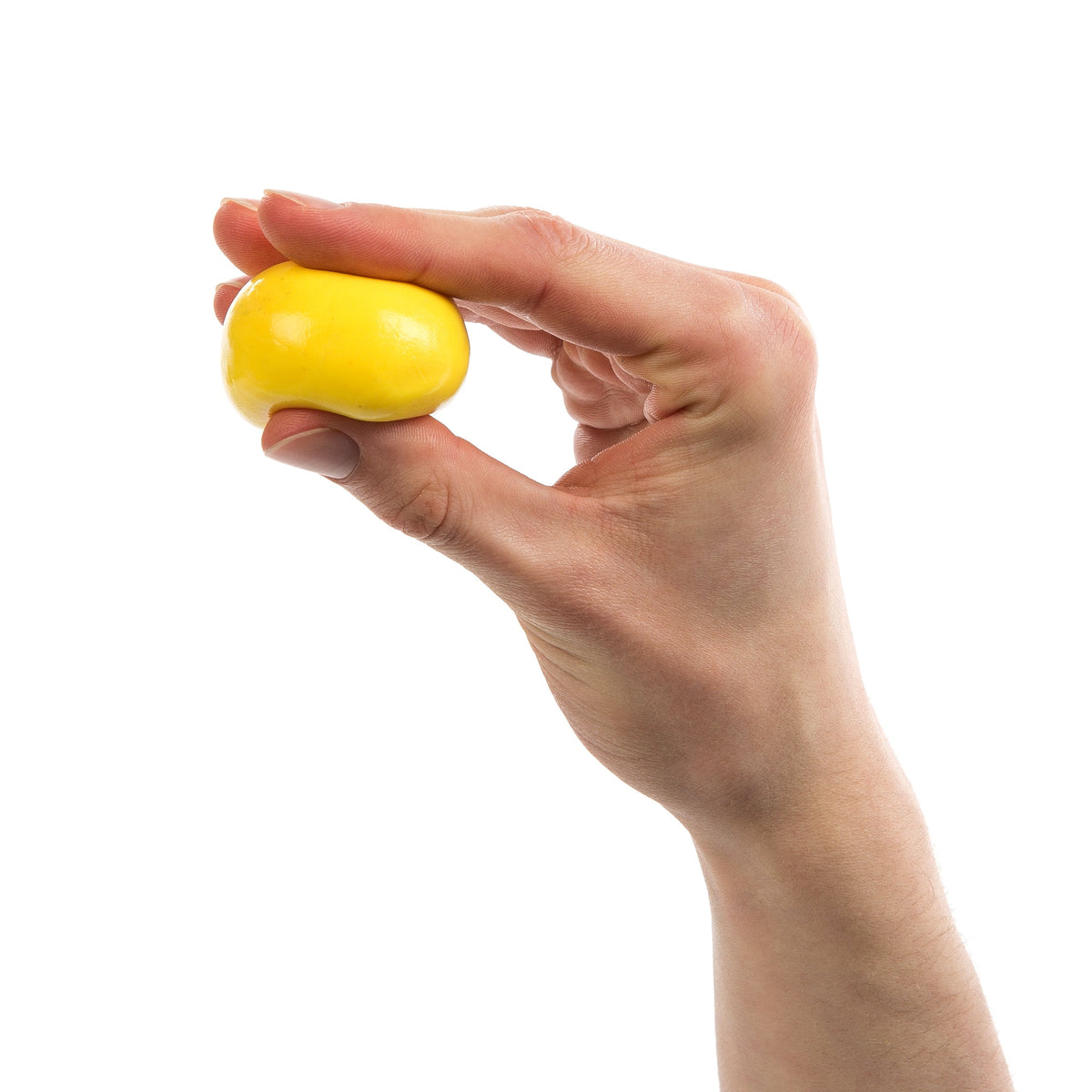
A soft, squeezable PVC or rubber ball, 18–25cm inflated. Compresses under load, returns to shape. Used for between-knees adduction work, under-spine articulation, behind-the-back shoulder cues and core-engagement feedback drills.
Sizes: 18cm, 22cm, 25cm
Use: Classical mat Pilates, postural cueing
Price: £5–15
Buy this first if you do mat Pilates.
CATEGORY 02
Medium fitness ball
A firmer-inflated 25–30cm ball, sometimes weighted. Bridges classical small-ball work and full gym-ball exercises. Useful for advanced Pilates, partner-passing drills and shoulder-rehab progressions.
Sizes: 25cm, 28cm, 30cm
Use: Intermediate Pilates, light rehab
Price: £10–25
Skip unless your teacher asks for one.
CATEGORY 03
Anti-burst gym ball
A 45–75cm anti-burst PVC ball you sit on, lie over or stand against. Anti-burst means a slow controlled deflation if punctured, not a sudden pop. The same ball is sold as gym ball, exercise ball, Swiss ball, fit ball or birth ball — they are the same product.
Sizes: 45 / 55 / 65 / 75cm
Use: Full-body, pregnancy, rehab, desk
Price: £10–30
Buy this second — size by height.
A 65cm anti-burst gym ball is overkill for between-knees Pilates work, and a 18cm soft ball is useless as a birth ball. The category matters more than the brand.
CH 02 · SMALL BALL
The small Pilates ball (18–22cm) — squeezable, classical use
The small Pilates ball is what most classical mat-Pilates teachers mean when they say “grab a ball.” Inflated to about 80% capacity, it should compress noticeably when squeezed between knees or pressed against the lower back — the give is the whole point. The original was the Overball developed by Toner-Pilates collaborators in the late 1990s; today the same form factor is sold by Trideer, Eono, Body-Solid, Manduka and dozens of others, in 18, 22 and 25cm variants. Body Control Pilates Association teaching manuals use the term “soft ball” and specify 18–25cm depending on the exercise.
What you actually use it for: between-knees adduction drills in supine bridge (the ball gives you a target to squeeze, which automatically engages the inner thighs and pelvic floor); under-spine articulation in mid-back rolling and short-spine warm-ups (the ball gives a small unstable surface to articulate around); behind-the-back shoulder cues (the ball between shoulder blades and a wall gives feedback that posture has collapsed); and standing balance drills with the ball under one foot. A handful of UK teachers also use 18cm balls for pelvic-floor cueing post-natally — the squeezable feedback is gentler than a hard pad.
At flexa.fit our Pilates Ball (18cm) is the small-format option at £2.99 — classical 18cm, PVC, hand-pumpable via the small straw included. We deliberately don’t make 22cm or 25cm variants; teachers we talked to said the 18cm is what gets reached for nine times out of ten. Honest comparison: if you want a natural-rubber alternative for known PVC sensitivity, Manduka carries a small rubber ball in the £15–20 range; for most adults, our 18cm PVC version does the same work for less money.
Editor’s Note
Don’t over-inflate. A small Pilates ball should give 4–5cm under a firm hand-press. If it feels like a tennis ball, let some air out — firm small balls bruise ribs in supine work and stop providing the proprioceptive feedback that’s the entire point of the exercise.
CH 03 · MEDIUM BALL
The medium fitness ball (25–30cm) — the bridge most people skip
The medium fitness ball — usually 25 or 28cm — is the least-bought of the three and the one with the most muddled positioning. Confusingly, some manufacturers (Reebok, JLL) sell their 25cm balls as “Pilates balls,” while others (Trideer, Yes4All) sell the same ball as a “mini exercise ball.” Functionally it sits between the small soft ball and the gym ball: too firm to squeeze meaningfully between the knees, too small to sit on for desk use. It comes into its own in three places.
First, weighted Pilates — the 25cm Toning Ball developed by STOTT Pilates and copied widely is a 1–2kg medium ball used for overhead reaching and partner-pass drills in intermediate matwork. Second, shoulder rehab — a 25cm ball pressed wall-to-shoulder gives a more graded resistance than the 18cm for late-stage rotator cuff progressions, and chartered physios in CSP-registered clinics sometimes specify this size. Third, seated core work for older adults — a 25–30cm ball is small enough to sit on while balancing in a chair, which keeps the falls risk low compared to a 65cm ball.
Honest answer: most UK home users don’t need a medium ball. If a teacher specifically asks for one, buy it; otherwise skip this category, save the £15, and put it toward the gym ball below. flexa.fit doesn’t currently make a 25cm ball — we’d rather flag that gap than oversell our 18cm into a job it isn’t designed for. Trideer and Eono both have credible 25cm options in the £12–18 range.
CH 04 · GYM BALL
The gym / exercise ball (45–75cm) — full-body, pregnancy, desk
The 45–75cm anti-burst gym ball is the workhorse. It is the same ball whether you call it a gym ball, exercise ball, Swiss ball, fit ball, stability ball, birth ball or yoga ball — the only meaningful product specification is the diameter, the burst rating, and the PVC formulation. Used for full-body Pilates (over-ball rolls, pike-ups, hamstring curls), pregnancy work (perineal opening, contraction-rocking, post-partum gentle bouncing), back rehab (lumbar extension, supine bridge progressions), and as an active-sitting desk chair for posture training in 20-minute blocks.
The single most-important spec is anti-burst. A normal PVC ball, if punctured under load, pops audibly and drops the user. An anti-burst ball is constructed so that a puncture causes slow controlled deflation — over 30 seconds to two minutes — giving the user time to step off. For Pilates this matters; for pregnancy, where the ball is used during labour and recovery, anti-burst is non-negotiable. The relevant standard is BS EN ISO 20957-9, the British/European standard for stationary training equipment covering elastic-resistance and exercise balls, which specifies burst-resistance test loads of around 300kg. Look for “anti-burst” and ideally “tested to BS EN ISO 20957” or “EN ISO” on the packaging or product page.
At flexa.fit our Anti-Burst Gym Ball ships in four sizes — 45cm (£7.99), 55cm (£8.99), 65cm (£9.49) and 75cm (£9.99) — in textured non-slip PVC with a hand-pump in the box. Pump to roughly 90% capacity for stability; full inflation makes the ball feel bouncy and stops it sitting still under load. Honest comparison: if you want a German-engineered, fully eco PVC, look at Togu Powerball ABS for £45–70 — the build quality is noticeably higher, but for once-or-twice-a-week home Pilates and pregnancy use, a sub-£15 anti-burst ball replaced every 2–3 years works fine.
CH 05 · SIZE BY HEIGHT
Sizing a gym ball by height — knees at 90°
The rule of thumb that every gym-ball manufacturer publishes is the same: when you sit on the inflated ball with both feet flat on the floor, your knees and hips should both be at about 90°. If your knees are higher than your hips, the ball is too small. If your hips are higher than your knees, it’s too big. Body Control Pilates teachers use the same cue and add: if you’re between sizes, size down for active Pilates work (a slightly smaller ball is more stable under load) and size up for pregnancy and desk use (a slightly bigger ball opens the hips more).
| Your height | Recommended gym ball size | flexa.fit price |
|---|---|---|
| Under 152cm (5′0″) | 45cm | £7.99 |
| 152–167cm (5′0″–5′6″) | 55cm | £8.99 |
| 168–180cm (5′6″–5′10″) | 65cm | £9.49 |
| Over 180cm (5′10″+) | 75cm | £9.99 |
These sizings are consistent across Trideer, Eono, Reebok and Pro-Tec product pages, and the British Heart Foundation’s general fitness-equipment guidance uses the same height bands. If a shop assistant suggests a different size for desk use, that’s reasonable — some active-sitting users prefer a 65cm even at 5′5″, because the slight forward pelvic tilt encourages a more neutral lumbar curve when typing. Sizing is a starting point, not a law.
“The simplest practical sizing rule is to sit on the inflated ball: knees and hips should both form right angles, with feet flat on the floor. Anything more complicated is marketing.”
CH 06 · SIZE BY USE CASE
Sizing by use case — Pilates, pregnancy, rehab, desk, general fitness
Mat Pilates — 18cm soft ball + height-matched gym ball
For classical mat Pilates, the small 18cm soft ball does 80% of the work (between-knees, under-spine, shoulder cues). Add a height-matched 55/65/75cm gym ball for over-ball rolls, pike-ups and hamstring curls once you’re past the first 8 weeks. See our UK beginners’ guide.
Pregnancy / birth ball — size up by one
The NCT labour-positioning guidance notes that birth-ball use can help during labour, particularly for back pain and all-fours positioning; midwives typically recommend sizing one up from your normal height-band — so 65cm for most 5′0″–5′6″ women, 75cm for taller. The bigger ball keeps hips higher than knees, which opens the pelvic outlet. Anti-burst is mandatory.
Rehab — let your physio specify
For lumbar, shoulder or post-surgical rehab, ask your CSP-registered physio which size and category. Common prescriptions: 18cm for early pelvic-floor cueing, 25cm for late shoulder progressions, 55–65cm for full lumbar extension over the ball. Avoid the “biggest ball you can find” mistake — rehab balls are sized down to keep loads controllable.
Desk chair — height-matched, anti-burst, 20 mins max
If you’re going to swap your desk chair for a ball, match it to your height (knees at 90° rule above), use it in 20-minute blocks not full days — we covered the evidence on this — and make sure the ball is anti-burst.
General fitness / HIIT — firmer-inflated 55 or 65cm
For dynamic exercises (jackknives, hamstring curls, dumbbell-pressing supine on the ball) pick height-matched and inflate fully — a firmer ball is more stable under load and rolls less. Lower your inflation by 10% if you’re using the ball for slow controlled Pilates work.
CH 07 · SAFETY
The anti-burst safety standard — why BS EN ISO matters
An exercise ball is essentially a thin-walled PVC bladder being asked to hold an adult human body at pressure. When a non-anti-burst ball is punctured under load — you sit down on a stray drawing pin, the cat sinks a claw in — it pops violently and drops the user to the floor. The British Standards Institution publishes the relevant standard as part of BS EN ISO 20957, the multi-part standard for stationary training equipment; part 9 covers elastic-resistance training devices including exercise balls. Anti-burst construction sandwiches the PVC with a reinforcing layer that, if punctured, channels air out slowly over 30 seconds to two minutes.
The numbers manufacturers publish: a credible anti-burst gym ball will be marked “tested to 300kg” or “static load 500lb,” meaning the burst-resistance test holds those weights without rupturing. flexa.fit’s Anti-Burst Gym Ball is tested to 300kg static load. For pregnancy use, the Royal College of Obstetricians and Gynaecologists physical activity guidance and most NHS antenatal teams now specifically request anti-burst balls for in-hospital use — if you’re buying a birth ball, check the listing for the anti-burst term explicitly.
No anti-burst label = don’t buy it for pregnancy or rehab. The price difference between a non-anti-burst and an anti-burst gym ball is usually under £3.
CH 08 · MATERIALS
Materials — PVC, natural rubber and phthalate-free
Almost every UK-sold Pilates and gym ball is made from PVC (polyvinyl chloride). PVC is durable, easy to mould seamlessly, and cheap — which is why a 65cm gym ball costs £10 not £100. The two material questions that matter for buyers are phthalates (the plasticisers that make PVC soft) and latex (sometimes used in valves or alternative-material balls).
Phthalates are restricted in EU/UK consumer goods under REACH regulation. Any ball legally sold for fitness use in the UK should be phthalate-restricted — you’ll see “phthalate-free” or “6P-free” on the packaging. Six phthalates (DEHP, DBP, BBP, DIBP, DPENP, DHEXP) are banned in toys and childcare articles, and reputable adult fitness brands voluntarily extend the same standard. flexa.fit’s balls are phthalate-free PVC; check the listing if you’re buying from an unfamiliar marketplace seller.
Latex is only relevant if you have a diagnosed latex allergy — most modern gym balls don’t contain latex, but some older or specialist models use latex valves. Allergy UK notes that latex sensitivity in the general adult population is around 1–2%, but higher in healthcare workers; if that’s you, check the product page for “latex-free” explicitly. For small Pilates balls, natural-rubber alternatives (some Manduka small balls, specialist studio props) are an eco option but can trigger latex reactions — the “natural rubber = better” assumption isn’t universal.
CH 09 · INFLATION + CARE
Inflation tips and care — getting the right firmness
The single most-common mistake first-time buyers make is over-inflating. Both small Pilates balls and gym balls work better at roughly 90% capacity, not 100%. A slight give is what makes the ball stable under load and prevents the bouncy, rolling-out-from-under-you feeling that drives beginners away. Use the supplied straw (small ball) or pump (gym ball), inflate over 5–10 minutes — never in one go — and stop when the ball still has a millimetre or two of compression under firm hand-press.
For a gym ball, the published diameter (e.g. 65cm) is the fully-inflated size. Inflating to 90% gives you roughly 58–60cm of usable diameter. If you’re between height bands, this is why sizing up by one for desk/pregnancy use is sensible: you inflate slightly under-full, get the diameter you actually want, and have a softer-feeling ball.
Care: wipe with a damp cloth after sweaty sessions, store away from direct sunlight (UV degrades PVC over time), and keep balls off concrete/gritted gym floors — most punctures come from grit underfoot, not from the workout itself. A well-cared-for anti-burst gym ball lasts 2–3 years of regular UK home use; a small Pilates ball lasts 3–5 years.
Editor’s Note
After the first inflation, leave the ball at room temperature overnight before using it. PVC stretches under pressure for the first 24 hours; if you inflate fully and use immediately, the ball will feel under-inflated by morning. Top up after 24 hours, then use normally.
CH 10 · THE FLEXA.FIT RANGE
How flexa.fit’s range fits these categories
Plain version: we make two of the three categories. The small 18cm soft ball, and the 45/55/65/75cm anti-burst gym ball. We don’t make a 25cm medium fitness ball — we’d rather flag it as a gap than oversell our 18cm into the wrong job. For most UK home users, the 18cm + height-matched gym ball pairing covers classical Pilates, pregnancy, desk use and rehab, which is why we focused product development there.
| Need | flexa.fit pick | Price |
|---|---|---|
| Classical mat Pilates (small ball drills) | Pilates Ball (18cm) | £2.99 |
| Intermediate Pilates weighted/medium ball | Not stocked — try Trideer or Eono 25cm | — |
| Petite adult < 5′0″ / older child Pilates | Anti-Burst Gym Ball 45cm | £7.99 |
| 5′0″–5′6″ height — Pilates, desk, mat work | Anti-Burst Gym Ball 55cm | £8.99 |
| 5′6″–5′10″ height / pregnancy 5′0″–5′6″ | Anti-Burst Gym Ball 65cm | £9.49 |
| 5′10″+ height / pregnancy taller users | Anti-Burst Gym Ball 75cm | £7.99 |
If you want eco-certified natural rubber or a brand with longer-tenured manufacturing credentials, look at Togu (Germany) or Manduka for small-ball alternatives — we don’t compete on those specs and won’t pretend otherwise. We compete on price, anti-burst certification, in-box pump and same-day UK dispatch.
FLEXA.FIT NEWSLETTER
Get 10% off your first order
Join thousands of UK customers using flexa.fit. Sign up for product guides, buying tips, and a 10% discount sent to your inbox.
No spam, unsubscribe any time. UK customers only.
ANSWERS · FAQs
FAQs about how to choose a pilates ball
What size pilates ball should I buy for general use?
For classical mat Pilates an 18cm soft ball; for full-body Pilates, desk use or rehab a height-matched gym ball — 55cm for 5′0″–5′6″, 65cm for 5′6″–5′10″, 75cm above. If you only buy one, buy the gym ball; if you already do studio mat Pilates, buy the 18cm first because the small ball does the foundational squeeze and articulation drills the larger ball can’t.
Is a 65cm gym ball too big for Pilates?
For most adults 168–180cm tall, no — 65cm is the right size for full-body Pilates exercises (over-ball roll-outs, pike-ups, hamstring curls). For between-knees and under-spine work you still need the small 18cm soft ball; a 65cm is too large for those drills. The two categories complement rather than replace each other.
Can I use a small Pilates ball as a birth ball?
No. A small 18cm Pilates ball is far too small to sit on as a birth ball — you need a 65cm or 75cm anti-burst gym ball for pregnancy and labour positioning. NCT labour guidance recommends sizing up by one band from your normal height, with anti-burst construction mandatory. See our pilates ball for pregnancy UK guide for safe selection and exercises.
What does anti-burst mean and does it matter?
Anti-burst means that if the ball is punctured under load, it deflates slowly over 30 seconds to two minutes rather than popping suddenly. The British/European standard is BS EN ISO 20957-9. For Pilates and pregnancy use, anti-burst is essential — the price difference is usually under £3 and the safety difference is significant.
How much should I inflate my pilates ball?
Roughly 90% of full capacity, not 100%. The ball should give a millimetre or two under firm hand-press. Over-inflated balls feel bouncy and roll out from under you in supine work; under-inflated balls don’t provide the proprioceptive feedback that’s the entire point of using a ball. Inflate over 5–10 minutes, leave overnight, then top up the next day.
Are pilates balls phthalate-free and safe?
Any ball legally sold in the UK for fitness use should be phthalate-free under REACH regulation — the six restricted phthalates (DEHP, DBP, BBP, DIBP, DPENP, DHEXP) are banned in toys and most adult fitness brands voluntarily extend the same standard. Check the listing for “phthalate-free” or “6P-free” if buying from an unfamiliar marketplace seller. Latex sensitivity is rare in the general population but worth checking if you have diagnosed allergy — most modern balls are latex-free.
Can I use a gym ball as a desk chair?
In 20-minute blocks rather than all day, yes. The peer-reviewed evidence is mixed — we covered it in our gym ball vs desk chair guide. The short version: short active-sitting blocks alternated with a proper chair gives most of the postural benefits without the fatigue. Use a height-matched anti-burst ball.
MEDICAL & SAFETY DISCLAIMER
This guide is general fitness information, not individualised medical advice. If you are pregnant, recovering from surgery, managing a back, neck or pelvic injury, have diagnosed diastasis recti, or have any cardiac or neurological condition, speak to your GP, midwife or a Chartered Society of Physiotherapy-registered physiotherapist before starting a new Pilates programme or selecting a ball.
For pregnancy use, choose an anti-burst (BS EN ISO 20957-9) ball only, inflate to roughly 90%, and avoid using a ball if you experience dizziness, bleeding, ruptured membranes or other clinical concerns. Stop immediately and seek midwife/GP advice if any new symptom develops.
SOURCES
Sources
- Body Control Pilates Association — UK teacher training, matwork syllabus and prop guidance.
- Pilates Foundation — UK teacher directory and beginner equipment guidance.
- NHS — A guide to Pilates, Live Well section, accessed 2026.
- NCT — Pain in labour and positioning guidance covering birth-ball use and labour comfort.
- Royal College of Obstetricians and Gynaecologists — Physical activity and pregnancy patient information.
- Cruz-Ferreira A, Fernandes J, Laranjo L, Bernardo LM, Silva A (2011) — “A systematic review of the effects of Pilates method of exercise in healthy people,” Archives of Physical Medicine and Rehabilitation, 92(12): 2071–2081. PMID 22030232.
- Wells C, Kolt GS, Bialocerkowski A (2012) — “Defining Pilates exercise: a systematic review,” Complementary Therapies in Medicine, 20(4): 253–262. PMID 22579438.
- British Standards Institution — BS EN ISO 20957 series, stationary training equipment standards including elastic-resistance training devices.
- European Chemicals Agency — REACH regulation on phthalates and consumer-goods chemical restrictions.
- Allergy UK — Latex allergy patient information and prevalence data.
- Chartered Society of Physiotherapy — UK register of chartered physiotherapists for rehab ball-prescription referrals.
- Trideer — manufacturer published gym-ball sizing chart referenced for height-band cross-validation.
- Eono (Amazon-brand) — published gym-ball specifications referenced for sizing comparison.
- Manduka — natural-rubber alternative small-ball reference.
Related reading: Best Pilates Ball for Pregnancy UK · Pilates for Beginners: UK At-Home Guide · Pilates Ball vs Desk Chair · Beginner Pilates Ball Exercises at Home · How Much Does a Pilates Ball Cost.
Share:
Are Expensive Yoga Mats Worth It? An Honest UK Buyer's Analysis (2026)
Foam Roller, Lacrosse Ball or Spiky Ball: Which Recovery Tool for What (2026)