
This guide walks UK home users, runners, lifters and desk workers through exactly how to use lacrosse ball on glutes for trigger-point release. You will learn the three glute layers and piriformis, four positions that cover every angle, safe dwell times and breathing cues, plus the signs that mean you should stop and see a physio rather than push through.
TL;DR
- The glutes are three muscles (maximus, medius, minimus) sitting over the piriformis. A lacrosse ball is firm and small enough to reach all four.
- Use four positions: seated on the floor, seated against a wall, lying on your back, and lying on your side.
- Dwell on a sore spot for 30 to 120 seconds. Breathe slowly. Stop sooner if pain spikes above a 7 out of 10.
- Never roll directly over the sciatic nerve. Sharp, shooting or radiating pain down the leg is a stop sign, not a "work through it" signal.
- Avoid lacrosse ball release on the glutes after recent hip or back surgery, during a pregnancy, on broken skin, or if you are on blood thinners without your GP's go-ahead.
- A 5 to 10 minute session, two or three times a week, is plenty for most UK home users.
Context and audience: who this guide is for
Glute tightness is one of the most common complaints we see from flexa.fit customers. Runners get it from miles of repetitive hip extension. Cyclists get it from hours seated and rotated forwards. Lifters get it from heavy squats and deadlifts. And the largest group of all, hybrid desk workers, get it from sitting eight hours a day with the glutes effectively switched off.
The NHS notes that most lower back pain is non-specific and improves with movement, gentle exercise and time. The glutes sit at the bottom of that picture. Tight, under-used glutes pull on the lower back, the SI joint and the hip rotators. A lacrosse ball is one of the cheapest, most direct tools you have for releasing them at home.
This is a self-care guide. It is not a substitute for hands-on physio assessment, and it is not appropriate for everyone (see the safety section below). If you have radiating sciatic pain, recent surgery, or unexplained back pain that keeps you awake at night, please see a GP or a Chartered Society of Physiotherapy registered physiotherapist first.
What the research says about self-myofascial release
The body of research on self-myofascial release (SMR) with foam rollers and small balls has grown steadily over the last decade. A 2015 systematic review in the International Journal of Sports Physical Therapy concluded that SMR appears to improve short-term flexibility without reducing muscle performance, which makes it a sensible pre-workout or recovery tool rather than a strength-training replacement.
A 2019 meta-analysis looking at pre-exercise and post-exercise effects of foam rolling found small but meaningful improvements in flexibility and reductions in delayed-onset muscle soreness. A 2013 study in the Journal of Strength and Conditioning Research found that two minutes of foam rolling per muscle group increased range of motion without hurting strength output, which is roughly where the 30 to 120 second per-spot dwell time we recommend below comes from.
The honest summary: SMR with a lacrosse ball will not "break up scar tissue" or "release fascia" in any literal mechanical sense, despite what some YouTube channels claim. What it does well is reduce perceived tightness, dial down the nervous-system tone in an overactive muscle, and improve short-term hip mobility. For most people that is enough to get back to training comfortably.
Glute anatomy in 60 seconds
To use a lacrosse ball well, you need a rough mental map of what you are pressing on. There are three glute muscles stacked in layers, plus the piriformis tucked underneath:
- Gluteus maximus. The outer, largest layer. The "shape" of your bum. It extends the hip (pushes you forward when you walk, run or stand up from a chair).
- Gluteus medius. Sits above and slightly to the side of gluteus maximus, on the upper-outer part of the hip. It stabilises the pelvis when you stand on one leg. Weak or tight glute med is a classic cause of runner's hip pain and Trendelenburg gait.
- Gluteus minimus. The deepest of the three, beneath glute med. Also a hip abductor and stabiliser. Hard to target directly with a foam roller, which is why a lacrosse ball is the better tool.
- Piriformis. A small, deep external rotator of the hip running from the sacrum to the top of the thigh bone. The sciatic nerve runs underneath it (and in about 17% of people, through it). Tight piriformis can mimic sciatica, which is why it is often the target of glute ball work. The Physiopedia entry on piriformis syndrome is a good plain-English overview.
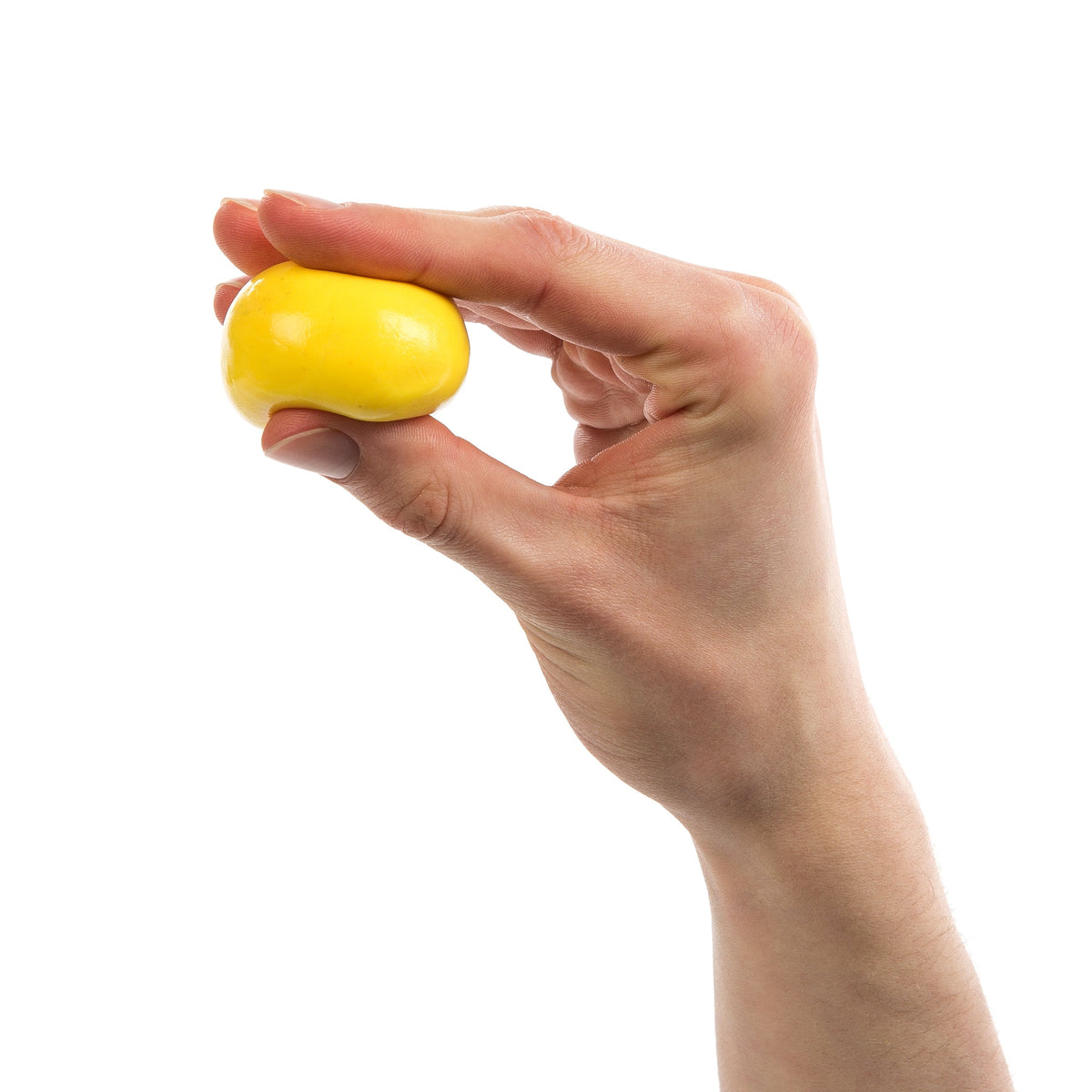
The trick with a lacrosse ball is that it is small enough (about 6.3 cm) and firm enough to sink past glute maximus and reach the layers underneath. A foam roller cannot do this. A tennis ball is too soft and deforms under bodyweight. That is exactly why a lacrosse ball is the standard tool for this job.

The flexa.fit Lacrosse Ball is regulation-density solid rubber, the same standard used in matches, which is what gives it the firmness to reach glute minimus and piriformis without collapsing. Free UK standard delivery on orders £30+, and MEGLIO10 takes 10% off your first order.
The four positions: how to use lacrosse ball on glutes step by step
Each of the four positions below targets the glute layers from a slightly different angle. You do not need to do all four every session. Pick one or two, find the spots that feel tightest, and work them. Aim for 5 to 10 minutes total.
Position 1: Seated on the floor (deepest pressure, advanced)
- Sit on the floor with your knees bent and feet flat. Place the lacrosse ball under one glute, roughly halfway between the top of your hip bone and your sit-bone.
- Lean back onto your hands, then slowly shift your weight onto the ball.
- To target glute medius, drop the same-side knee out to the side. To target piriformis, cross the ankle of the loaded leg over the opposite knee (a "figure four"). This puts the piriformis on stretch and exposes it to the ball.
- When you find a tender point, stop moving. Breathe in for four seconds, out for six. Hold the position for 30 to 120 seconds until the sharpness fades.
- Move 2 to 3 cm and repeat. Cover the upper-outer glute, the centre and the lower glute near the sit-bone.
This is the most intense option. New users should not start here. If you are unloading half your bodyweight onto a 6 cm ball and the pain is above a 7 out of 10, switch to position 2.
Position 2: Seated against a wall (controlled pressure, best for beginners)
- Stand with your back to a wall, feet about 30 cm out from the skirting board.
- Place the lacrosse ball between the wall and the upper-outer part of your glute (where glute medius sits).
- Lean into the wall to load the ball. The amount of pressure is set by how far you lean. This is what makes it the best entry point.
- Slowly bend the knees to roll the ball down through glute medius, into glute maximus, and finish near the sit-bone.
- Pause on sore spots for 30 to 60 seconds and breathe.
This is the one to start with if you have never done glute ball work before, or if you are returning to it after time off. You decide the pressure, not gravity.
Position 3: Lying on your back (best for deep glute and piriformis)
- Lie on your back with knees bent, feet flat. Lift your hips and place the ball under one glute, centred on the meatiest part of glute maximus.
- Lower your hips and let the ball sink in.
- Cross the ankle of the loaded leg over the opposite knee. This is the figure-four position again, and it puts piriformis directly over the ball.
- To search for a trigger point, slowly let the knees fall side to side a few degrees. Stop when you find a tender spot and hold for 60 to 120 seconds.
- Switch sides.
Position 3 gives you full bodyweight pressure but with much better support than position 1, because your shoulders and head stay grounded. Most people find this the most effective for piriformis.
Position 4: Lying on your side (isolates glute medius and minimus)
- Lie on your side. Place the lacrosse ball under the upper-outer part of your hip, where glute medius and minimus sit.
- Stack your knees, or stagger them with the top leg forward for more stability.
- Use your bottom forearm to control how much weight you put on the ball.
- Hold a tender spot for 30 to 90 seconds, then shift 2 cm and repeat.
This position is gold for runners with hip pain, cyclists with tight outer hips, and anyone with a one-sided IT band or knee issue, since those problems are often driven by an over-tight glute medius. For a fuller view of how this fits with other tools, the post on foam roller, lacrosse ball or spiky ball compares which tool to reach for in different situations.
Dwell time, breathing and pain rules
This is where most people get glute ball work wrong. They either roll for ten seconds and move on (no real effect), or they grit through agony for five minutes (which winds up the nervous system and makes things worse the next day). Use this protocol instead:
- Dwell time per spot: 30 to 120 seconds. Move on when the sharpness drops by about half, not when it disappears entirely.
- Pain scale: aim for a 4 to 6 out of 10. "Uncomfortable but bearable" is the sweet spot. Above 7 means you are bracing, your nervous system is fighting back, and the muscle will not release.
- Breathing: in through the nose for 4 seconds, out through the mouth for 6 seconds. The longer exhale is the bit that does the work. It cues your parasympathetic nervous system to lower muscle tone.
- Total session length: 5 to 10 minutes is the upper limit for most people. More than that is not better, and often leaves you bruised the next day.
- Frequency: two or three times a week, ideally after training or in the evening. Daily is fine for elite athletes during a heavy block but unnecessary for most home users.
The principle here is the same one underpinning myofascial release as a whole: slow, sustained, low-grade pressure with relaxed breathing, not aggressive grinding.
When to stop, and when not to start
This is the section most online guides skip, and it is the most important one. A lacrosse ball is a firm tool. Used in the wrong place, it can make things worse.
Stop the session immediately if:
- You feel sharp, shooting or electric pain that radiates down the back of the leg, into the calf or foot. That is nerve, not muscle. The NHS guidance on sciatica is the right next step, not more ball work.
- You feel any pins-and-needles, numbness or tingling.
- The pain spikes above a 7 out of 10 even with relaxed breathing.
- You feel pulsing or a noticeable artery underneath the ball (you are off-target, move the ball laterally).
Do not use a lacrosse ball on your glutes if:
- You have had recent hip, lower-back or pelvic surgery (less than 3 months, or until your surgeon clears direct pressure).
- You are pregnant. Hormone-driven ligament laxity changes how soft tissue responds to pressure, and lying flat for long periods after the first trimester is not recommended.
- You have an active sciatic flare with radiating leg pain. Get it diagnosed first.
- You are on blood-thinning medication or have a bleeding disorder. Speak to your GP first, since deep bodyweight pressure can cause bruising.
- You have broken skin, a bruise, or any open lesion over the area.
- You have a deep vein thrombosis, varicose veins of clinical concern, or any vascular condition in the lower limb.
- You have osteoporosis or low bone density that puts you at higher fracture risk.
The Chartered Society of Physiotherapy has straightforward UK guidance on back pain that is worth a read if you are unsure whether self-massage is appropriate for your situation. When in doubt, book a 30-minute physio session before you start.
Building it into a wider routine
A lacrosse ball is one tool. It works best as part of a wider mobility and strength routine, not as a stand-alone fix. For most flexa.fit customers we recommend pairing glute ball work with three things:
- Active glute strengthening: bridges, banded clamshells, single-leg deadlifts. The flexa.fit resistance loops are perfect for adding load to glute med activation. A 5 minute warm-up of these before training delivers more than passive release ever will.
- Stretching the related muscles: hip flexors, piriformis, hamstrings. The dedicated piriformis stretch guide is a useful companion piece if piriformis tightness is your main issue.
- General movement: the NHS Live Well exercise guidance aims for 150 minutes of moderate activity a week. Glutes that are used regularly do not need as much manual release as glutes that sit in a chair all day.
If your tightness is part of a wider lower-back picture, the home recovery kit and programme for lower back pain walks through how lacrosse ball work fits with stretching, strengthening and pacing. And if you specifically want a step-by-step for the lower back area itself, the post on how to use a lacrosse ball for lower back is the next read.
FAQs
How long should I hold a lacrosse ball on a glute trigger point?
Hold each spot for 30 to 120 seconds. The sweet spot for most people is 60 to 90 seconds. Move on when the sharpness in that spot has dropped by roughly half, not when it disappears entirely. If a spot still feels electric after two minutes, that is your signal to move the ball, not to push longer.
Can I use a lacrosse ball on my glutes every day?
For most UK home users, two or three sessions a week is plenty. Daily is fine for elite athletes during a heavy training block but tends to leave home users bruised and over-stimulated. If you find yourself reaching for the ball every day to manage the same pain, that is usually a sign you need active strengthening (or a physio assessment), not more passive release.
What is the best position for piriformis release?
Position 3 (lying on your back with the figure-four ankle cross) is the most direct. It uses full bodyweight pressure, but with shoulders grounded so you can relax. Stack the ankle of the loaded leg over the opposite knee, let the ball sink under the deep glute, and let the knees drift slowly side to side until you find the tender spot.
Should I use a lacrosse ball or a foam roller on my glutes?
Use both, for different jobs. A foam roller covers the broad surface of glute maximus and warms up the area. A lacrosse ball reaches the deeper layers (glute medius, glute minimus, piriformis) that a foam roller cannot. The post comparing foam rollers, lacrosse balls and spiky balls breaks down when to reach for each.
Is it normal for the glute to feel sore the day after?
A little soreness, similar to the day after a leg session, is normal and usually clears within 24 to 48 hours. Bruising, sharp pain, or pain that gets worse over two or three days is not normal. That means you pressed too hard, dwelled too long, or worked over a structure that was not muscle. Lay off the ball for a week and ease back in with position 2 against the wall.
Can I use a tennis ball instead?
You can, but it deforms under bodyweight and will not reach the deeper glute layers. A lacrosse ball is the standard tool for a reason. If you find a regulation lacrosse ball too firm to start with, use a tennis ball for the first week or two against a wall (position 2) to build tissue tolerance, then graduate to a lacrosse ball.
When should I see a physio instead of doing self-release?
Book a physio if you have radiating leg pain, numbness or tingling, pain that wakes you at night, pain after a fall or accident, or glute pain that has not improved with two or three weeks of consistent self-care. Use the CSP "Find a Physio" tool to locate a UK-registered physio in your area.
Conclusion
Knowing how to use lacrosse ball on glutes is one of the highest-return self-care skills for runners, lifters, cyclists and desk workers in the UK. The technique is simple: pick one of the four positions, sink onto a tender spot, breathe slowly for 30 to 120 seconds, then move on. Two or three sessions a week is enough for most people, and the protocol is at its strongest when paired with active glute strengthening rather than used in isolation.
Pay attention to the safety rules. Glute pain that radiates down the leg, that comes with numbness, or that gets worse over a few days needs a physio assessment, not more pressure. Treat the ball as one tool in a wider plan and it will repay you. The flexa.fit Lacrosse Ball is the same regulation density used by professional therapists, with free UK standard delivery on orders £30+, and 10% off your first order with code MEGLIO10.
This article is for informational purposes only and is not medical advice. Consult a qualified healthcare professional before starting any new exercise or self-care programme, especially if you have an existing condition, recent surgery, or injury.
Share:
Exercises Resistance Bands: Best Routines for 2026
What Size of Pilates Ball Do I Need: Complete 2026 Guide