This liforme yoga mat review covers everything UK yogis need to know before spending £125 on the Liforme Original — grip performance, the famous AlignForMe® marker system, eco credentials, and real-world durability — with honest comparisons against more affordable alternatives including the Flexa.fit Premium Yoga Mat 8mm as the top value pick for home practitioners and studio teachers.
TL;DR
- The Liforme Original is one of the best-gripping mats on the market, performing reliably in both dry and sweaty conditions.
- The AlignForMe® system is genuinely useful for beginners and alignment-focused practitioners; experienced yogis often find it less necessary.
- At £125, Liforme targets a premium audience — the price is justified if alignment feedback and eco credentials matter to you.
- Eco-conscious buyers will appreciate the natural rubber construction, B Corp certification, and biodegradable materials.
- If £125 feels steep, the Flexa.fit Premium Yoga Mat 8mm at £24.99 offers excellent grip and cushioning at a fraction of the cost.
- Neither mat is perfect: Liforme is heavy and expensive; the Flexa.fit mat lacks the alignment markers and premium finish.
Context: why the Liforme mat has such a devoted following
Liforme launched in 2013 with a single, strongly-held belief: that most yoga mats were solving the wrong problems. Founder James Armitage spent years developing a mat that tackled grip failure on sweaty hands, poor postural feedback, and the environmental impact of PVC. The result was a mat that quickly became a cult object in UK yoga studios — and a recurring recommendation in instructor training programmes.
By 2026 the market for premium yoga mats has expanded significantly. Brands including Manduka, JadeYoga, and Gaiam compete at similar or higher price points. Yet Liforme continues to command remarkable loyalty — the Original carries a 4.9/5 rating across more than 5,000 reviews on the brand's own site. This review looks at whether that reputation holds up to scrutiny, and where the mat falls short for certain buyers.
UK yogis have specific considerations: studio floors often vary from sprung hardwood to cold concrete; damp weather affects how you arrive at practice; and value-for-money thinking is baked into how most people shop. All of those factors are weighed below.
Liforme yoga mat review 2026: the original mat in detail
Liforme original yoga mat — premium pick
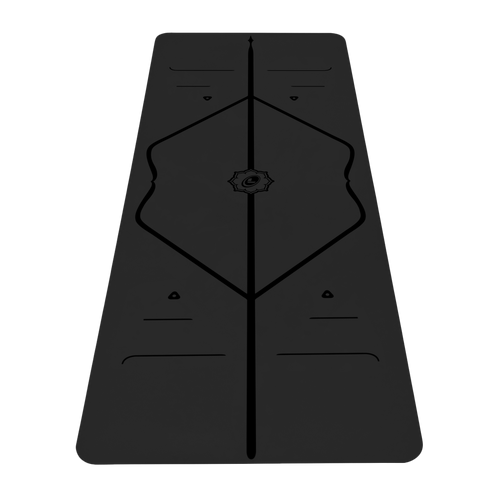
The Liforme Original is made primarily from natural tree rubber, engineered over a five-year development period. The GripForMe® top surface is a proprietary formula that bonds securely to both dry and sweaty palms — a meaningful advantage in flow, hot yoga, and Bikram classes where many budget mats become dangerously slippery. The base layer grips studio floors and domestic tiles effectively.
The signature feature — the AlignForMe® system — is a printed grid of lines and markers that guides hand and foot placement across poses. For newer practitioners it offers constant spatial feedback without requiring a teacher's correction. For intermediates and advanced yogis it can feel cluttered, though most report tuning it out within a few sessions. The markers are applied using inks Liforme spent over two years making non-toxic, which feeds into the broader eco story.
Dimensions sit at approximately 185 cm × 68 cm — longer than most entry-level mats and generously wide. Thickness is around 4.2 mm: enough cushioning for knee-heavy sequences, though not as plush as an 8 mm mat for floor work. The mat weighs roughly 2.5 kg, which is on the heavier side for carry; it comes with a carry strap but is noticeable on a bike or a long walk to the studio.
Liforme is a certified B Corporation, meaning the business meets independently verified standards for social and environmental performance. The mat itself is PVC-free, non-toxic, and designed to biodegrade within one to five years in normal landfill conditions — a claim backed by their own R&D rather than third-party certification, worth noting. Packaging is plastic-free and fully recyclable.
The price is £125 for the Classic version. Designer and printed variants run from £150 to £160. Liforme backs every mat sold directly with a money-back guarantee.
- Pros: Exceptional wet and dry grip; AlignForMe® guides posture for beginners; natural rubber construction; B Corp certified; biodegradable materials; long and wide format
- Cons: Heavy at ~2.5 kg; among the most expensive mats in the UK; AlignForMe® markers can feel distracting for advanced practitioners; natural rubber latex means it is unsuitable for severe latex allergies
- Best for: Serious home yogis, studio regulars, hot yoga practitioners, and environmentally-minded buyers who want a mat that will last and perform in demanding conditions
- Price: From £125 | Buy direct from Liforme
Flexa.fit Premium Yoga Mat 8mm — Best Value Alternative

For buyers who find the Liforme price hard to justify — particularly those building a home practice or equipping a studio for group use — the Flexa.fit Premium Yoga Mat 8mm is the strongest value option available from a UK brand. At £24.99 it costs roughly one-fifth of the Liforme Original, yet delivers grip performance and cushioning that comfortably outpaces most mats in its bracket.
The 8 mm thickness is the headline advantage over Liforme. Kneeling sequences, prone stretches, and floor-based Pilates all feel noticeably more comfortable than on a 4 mm mat. That extra cushioning is especially valuable on hard domestic floors — kitchen tiles, laminate, or bare concrete in a garage gym. The closed-cell PVC construction grips well on dry surfaces and holds up to regular cleaning; it will not absorb sweat the way open-cell mats can. The surface is not as demonstrably grip-secure in very sweaty hot yoga conditions as the Liforme GripForMe® layer, which is worth acknowledging honestly.
There are no alignment markers, no eco-certification, and no carry strap included. The mat is PVC rather than natural rubber, so it is the less sustainable choice over a lifecycle basis. What it offers is an accessible, durable, generously cushioned mat that is well-suited to home Hatha, Yin, restorative yoga, and Pilates — and it can be used confidently in studio settings for most non-hot yoga styles.
This is not a replacement for the Liforme if alignment guidance, hot yoga grip, or eco credentials are your priority. It is, however, an excellent mat in its own right, and the £100 saving is difficult to ignore for most UK buyers.
- Pros: 8 mm thickness offers superior floor cushioning; excellent dry grip; great value at £24.99; durable closed-cell surface; easy to clean
- Cons: No alignment markers; PVC construction is less eco-friendly than natural rubber; not the first choice for hot yoga; no carry strap
- Best for: Home practitioners, beginners building a first serious mat, Yin and restorative yoga, Pilates, and studio owners equipping multiple mats on a budget
- Price: £24.99 | Available at Flexa.fit
Liforme vs alternatives: how they compare side by side
| Feature | Liforme Original | Flexa.fit Premium 8mm |
|---|---|---|
| Price | £125 | £24.99 |
| Thickness | ~4.2 mm | 8 mm |
| Material | Natural tree rubber | PVC |
| Grip (dry) | Excellent | Good |
| Grip (sweaty / hot yoga) | Excellent | Moderate |
| Alignment markers | Yes (AlignForMe®) | No |
| Eco credentials | B Corp; biodegradable; natural rubber | None stated |
| Weight | ~2.5 kg | ~1.8 kg (est.) |
| Latex-safe | No (natural rubber) | Yes (PVC) |
| Best use case | Studio, hot yoga, alignment-focused practice | Home practice, Yin, restorative, Pilates |
Who should buy the Liforme — and who shouldn't
The Liforme Original earns its price for a specific type of buyer. If you practise hot yoga or Vinyasa flow where sweat is constant, the GripForMe® surface is a genuine safety and performance upgrade over cheaper options. If you are working on alignment — particularly in teacher training or if you are new to structured yoga — the AlignForMe® markers provide feedback that would otherwise require a teacher present. If environmental impact matters to your purchasing decisions, Liforme is one of the more credible options in the market: B Corp certified, natural rubber, biodegradable, and shipping goods by sea rather than air.
The mat makes less sense if: you primarily do floor-heavy work where 8 mm cushioning would serve you better; you carry your mat a long distance and weight matters; you have a latex allergy (natural rubber is a latex-containing material); or you are buying multiple mats for a studio or class setting where the £125 per unit cost becomes prohibitive.
Research published in a review of yoga's physical and mental health effects consistently identifies regular, consistent practice as the mechanism through which benefits — improved flexibility, balance, pain reduction, and mental wellbeing — are achieved. The mat you actually roll out consistently, at a price that doesn't create guilt, is often more valuable than the technically superior mat you own.
For further reading on how to match a mat to your practice style, see our complete yoga mat buying guide and our ranked list of the best yoga mats for 2026.
FAQs
Is the Liforme yoga mat worth £125?
For hot yoga practitioners, alignment-focused students, and buyers who prioritise eco credentials, yes. The GripForMe® surface performs reliably in sweaty conditions where cheaper mats fail, and the B Corp certification and natural rubber construction are genuine differentiators. For general home practice, the value is harder to justify — you can get a high-quality mat for under £30 that handles most sessions well.
How does the Liforme yoga mat review compare to Manduka PRO?
Both sit at the premium end of the market. The Manduka PRO is thicker (6 mm vs 4.2 mm) and has a denser, closed-cell surface that many instructors prefer for longevity. Liforme's advantage is the AlignForMe® system and arguably better grip on sweaty hands. Manduka PRO costs around £120–£140 in the UK — similar price, different strengths. See our Manduka yoga mat UK review for a full comparison.
Does the Liforme mat work for hot yoga?
Yes — the GripForMe® surface is one of the main reasons hot yoga practitioners choose Liforme. The natural rubber construction and proprietary top layer maintain traction as hands and feet become wet with perspiration. That said, Liforme's own care guide recommends wiping the mat after each session and allowing it to air dry to preserve the surface over time.
Is the Liforme yoga mat suitable for people with latex allergies?
No. The mat is made from natural tree rubber, which contains latex proteins. People with confirmed latex allergies should avoid natural rubber mats and choose PVC, TPE, or cork alternatives. The Flexa.fit Premium Yoga Mat 8mm is PVC-based and is a suitable option for latex-sensitive practitioners.
How long does a Liforme mat last?
With regular use and proper care — wiping down after sessions, air drying, storing rolled (not folded), and keeping it away from direct sunlight — most users report 3–5 years of comfortable use. Liforme sells directly and backs its mats with a satisfaction guarantee. The mat's natural rubber construction means it will eventually degrade, which Liforme considers a feature rather than a flaw.
What is a good value alternative to the Liforme yoga mat review shortlist?
The Flexa.fit Premium Yoga Mat 8mm at £24.99 is our top value pick. It offers 8 mm of cushioning — noticeably more than Liforme's 4.2 mm — and reliable dry grip, making it well-suited for home Hatha, Yin, restorative yoga, and Pilates. It is not a direct like-for-like replacement for Liforme in hot yoga or alignment-focused practice, but for the majority of UK home practitioners it delivers excellent performance at a fifth of the price.
Can I use the Liforme yoga mat for Pilates?
Yes, though it is not specifically designed for Pilates. The 4.2 mm thickness is thinner than most dedicated Pilates mats; practitioners who spend significant time in prone or supine positions on hard floors may find the Flexa.fit 8 mm mat more comfortable. The AlignForMe® system does provide useful spatial awareness cues that translate reasonably well to Pilates footwork and positioning. For dedicated Pilates use, an 8 mm or thicker mat is generally recommended.
Conclusion
The Liforme Original remains one of the most technically accomplished yoga mats available in the UK in 2026. Its grip performance — particularly in sweaty conditions — is among the best on the market, and the AlignForMe® system offers real value for alignment-focused practitioners and beginners. The natural rubber construction, B Corp certification, and biodegradable materials are credible eco credentials in a category that has no shortage of greenwashing.
The case against is straightforward: £125 is a significant spend on a single piece of equipment, the mat is heavy to carry, and natural rubber is a latex-containing material that rules it out for allergy sufferers. For the majority of UK home practitioners doing general Hatha, Yin, or restorative yoga on domestic floors, the Flexa.fit Premium Yoga Mat 8mm at £24.99 delivers a more cushioned, latex-safe experience at a fraction of the cost. It is not the same product — it lacks alignment markers, hot-yoga grip, and eco credentials — but for most people's actual practice, it performs exactly as needed.
Buy Liforme if alignment guidance, hot yoga grip, and environmental credentials justify £125 to you. Choose the Flexa.fit Premium 8mm if you want excellent cushioning and grip at a price that lets you get on with practising rather than worrying about your investment.

Share:
Jade Yoga Mat Reviews 2026: Honest UK Verdict on Harmony and Voyager
Manduka vs Jade Yoga Mat 2026: Honest Head-to-Head for UK Yogis